Glaze Reactions with a rutile inlay
A glossy black iron glaze containing cobalt, with silvery micro-crystalline
inclusions, has an inlay
The matrix (i.e., background) glaze and inlay glaze overlap minimally before
firing. The width of the
The background glaze is oribe-satIron; the inlay design is glazed with
hiAlk_Z3P_Z3V_0
The design is created by adhering a mask and then applying the main
glaze. After drying,
The close-up images were heavily edited to enhance detail and colors are
brighter as a result.
150 deg F an hour to 250 deg F
300 deg F an hour to 1800 deg F
200 deg F an hour to 2050 deg F
120 deg F an hour to 2320 deg F with a hold of 20 minutes at 2320 deg F
300 deg F an hour to 1850 deg F then a 2 hr hold at 1850 deg F
300 deg F an hour to 1750 deg F then a 1 hr hold at 1750 deg F
300 deg F an hour to 1700 deg F then a 3 hr hold at 1700 deg F
25 deg F an hour to 1650 deg F then a 1 hr hold at 1650 deg F
K2O 0.15
Al2O3 0.52
SiO2 3.39
molecular percent Silica 65.57%
Added:
5.0% cobalt carbonate
K2O 0.17
Al2O3 0.63
SiO2 3.50
molecular percent Silica 62.6%
Rutile alters colors; the green seen faintly in the inlay is the result of
the interaction of rutile
The various shades of brown are iron colors. The red seen in the lower part of
the third closeup
The background glaze has a cellular structure of abutting micro-crystalline
clusters, edged by, and
It is this glassy matrix which is most readily invaded by the downward flowing,
thickly applied
glaze containing rutile. The resulting design
exhibits a multitude of iron colors in an intricate lacy pattern.
original inlay varied from an eighth of an inch to
three eighths of an inch.
the mask is removed and the open area filled in with a
second glaze, using a bulb syringe
with a needle applicator.
The colors of the full image of the bowl are as they
appear in bright light.
Close up Images of the interaction region
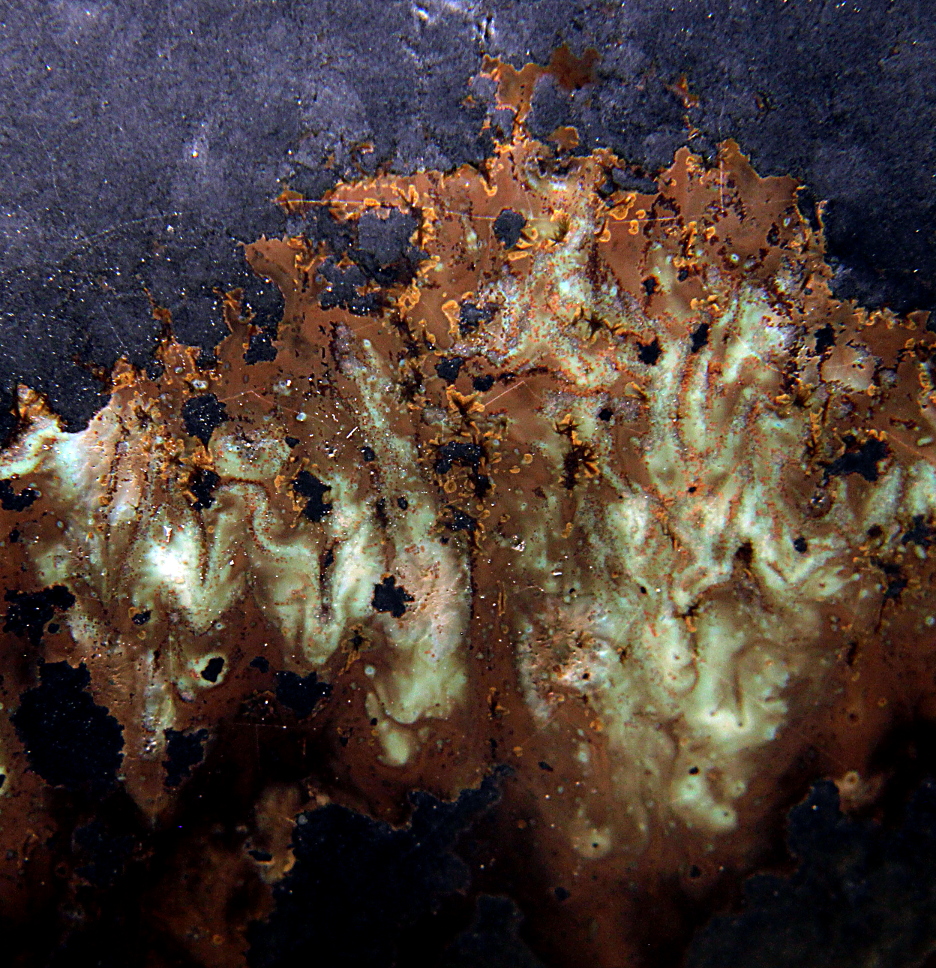
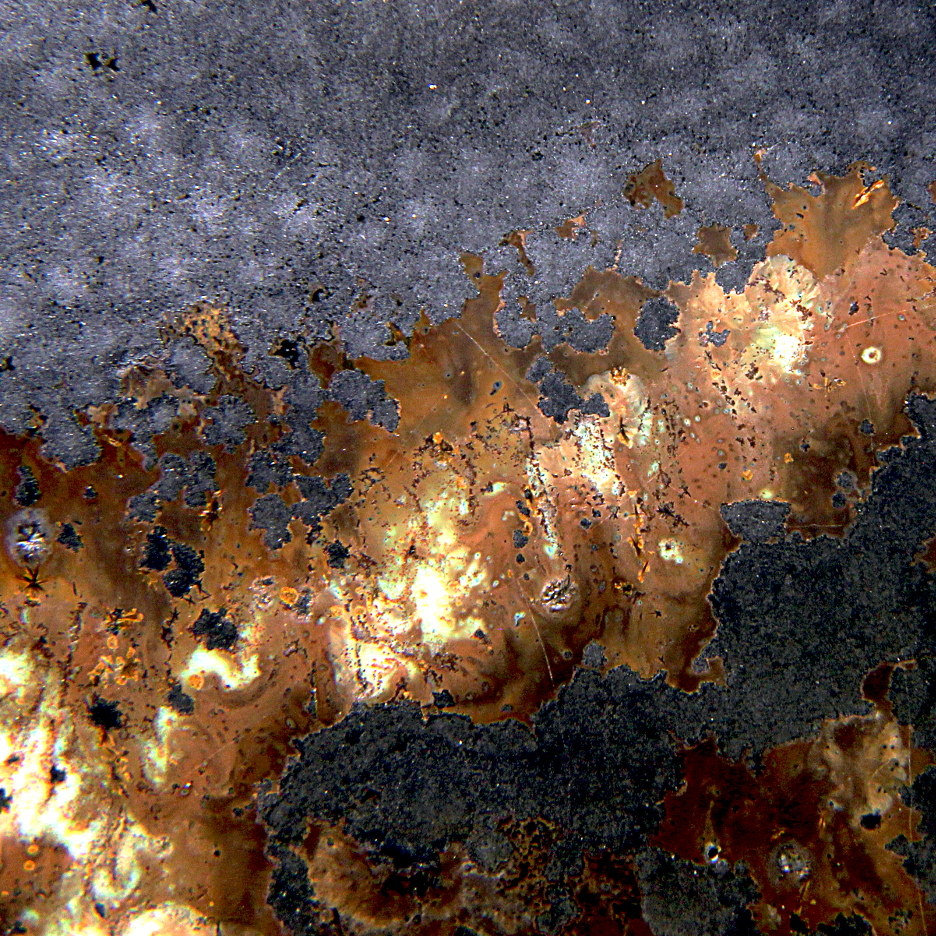
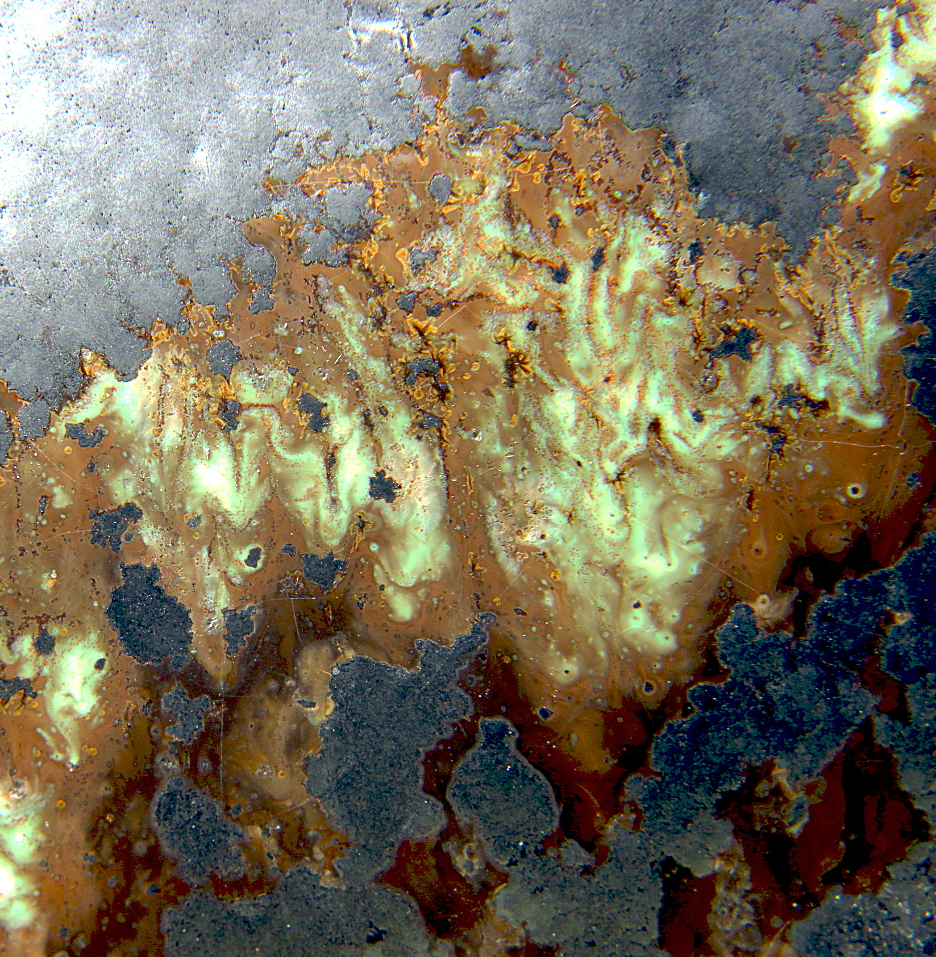
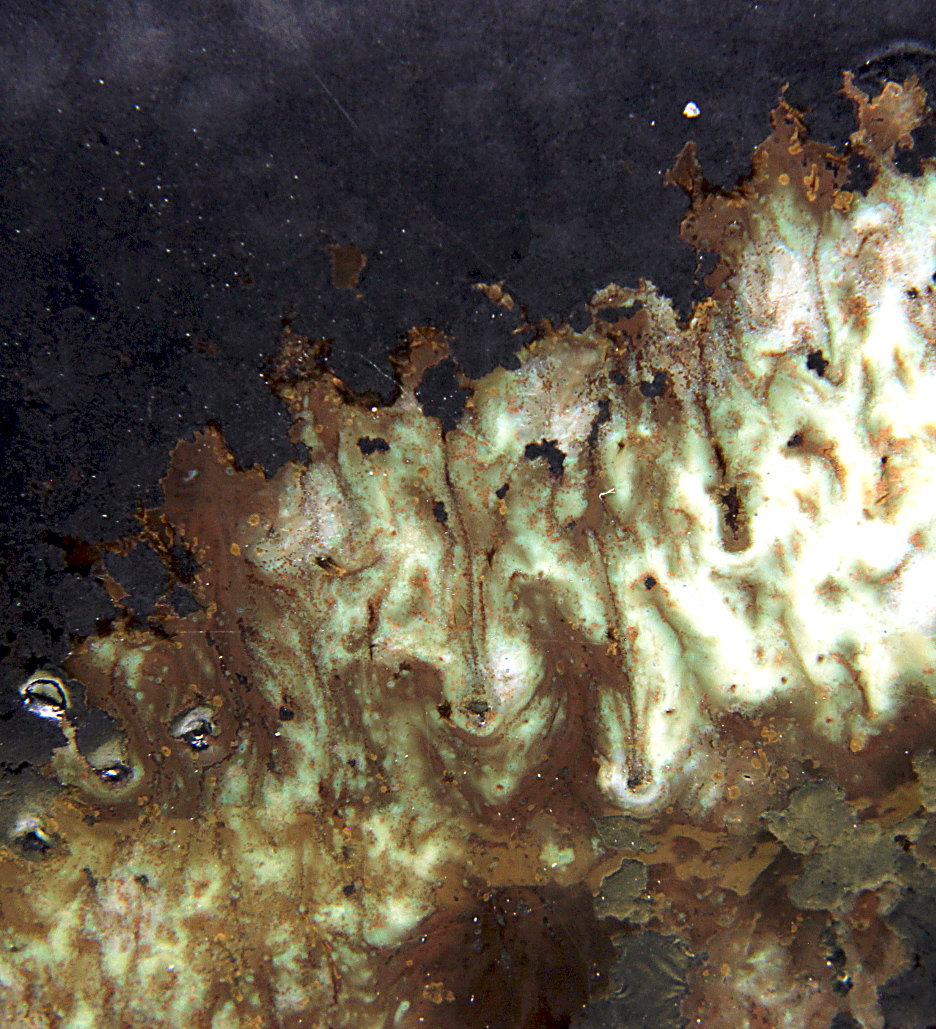
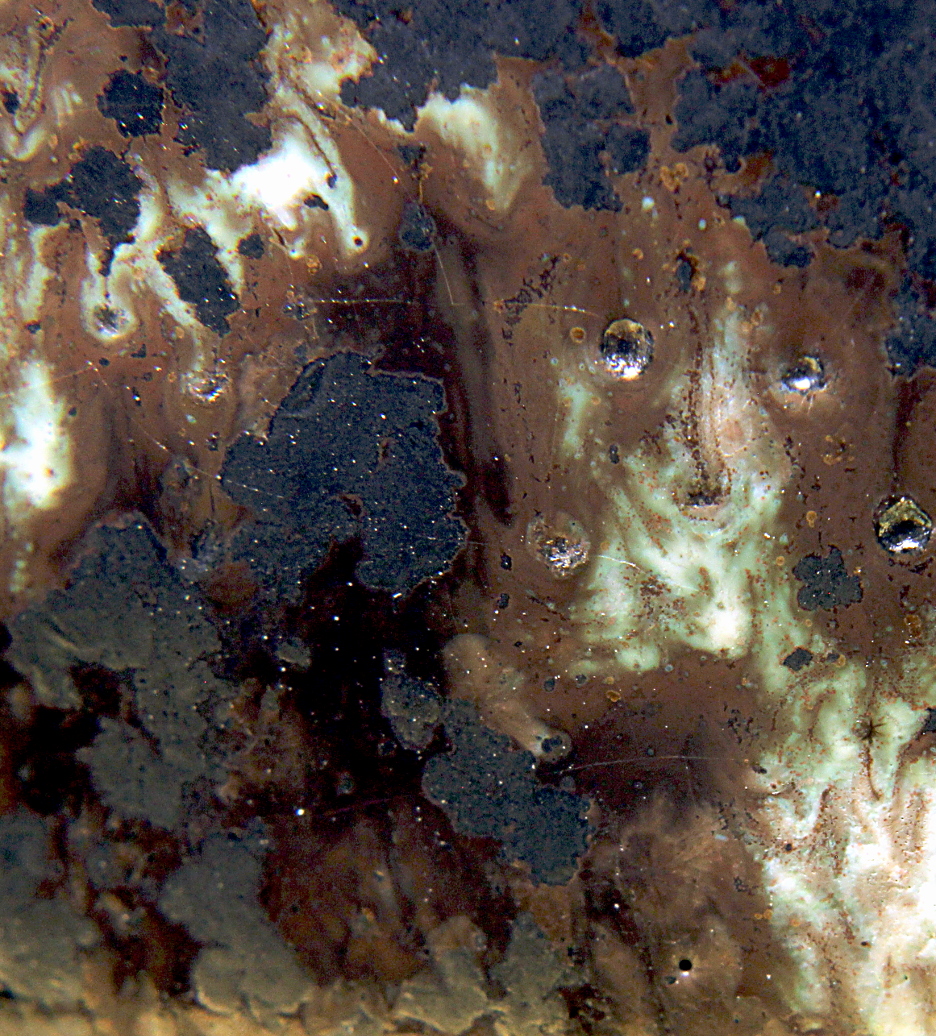
Image of the piece
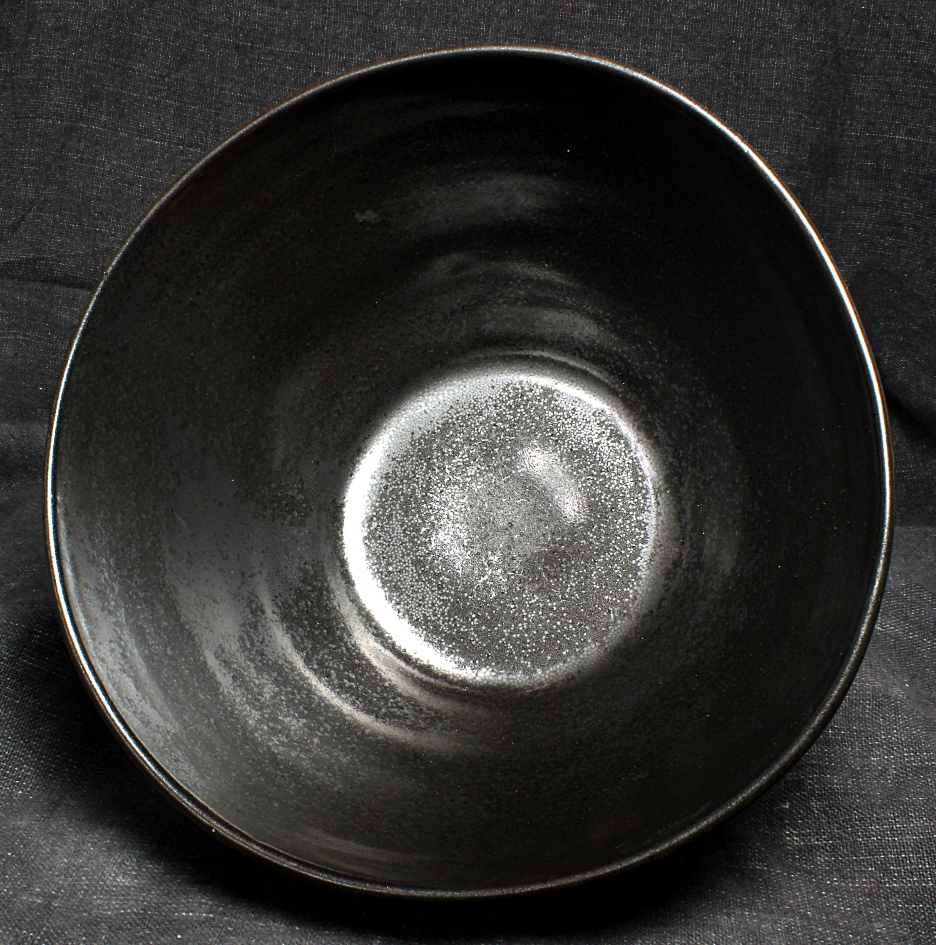
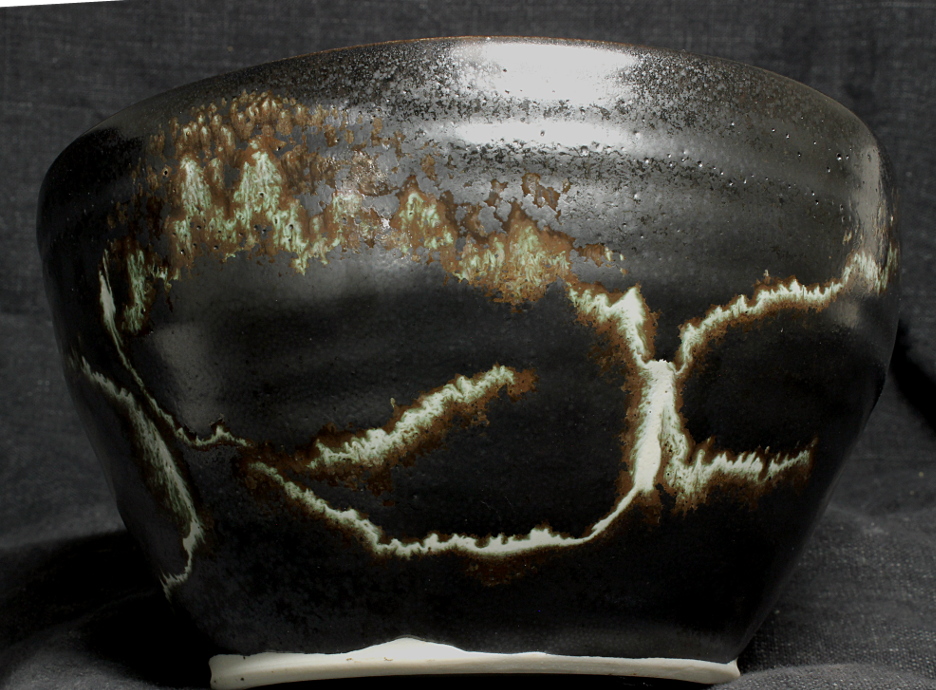
bowl with glaze oribe-satIron and inlay glaze hiAlk_Z3P_Z3V_0_PTi
bowl is ~6 inches in diameter
oxidation firing to hot cone 10 in an electric kiln
Firing profiles
Up Fire profile hot cone 10
Down Fire Profile hot cone 10
Clay body is a grolleg porcelain from Clay Art Center in Tacoma, WA.
glaze composition
Empirical Formula oribe-satIron :
Na2O 0.28
CaO 0.39
MgO 0.18
Fe2O3 0.21
P2O5 0.05
Inlay Glazes:
Empirical Formula hiAlk_Z3P_Z3V_0_PTi
Na2O 0.41
CaO 0.32
MgO 0.10
P2O5 0.07
TiO2 0.39
Remarks
from the inlay glaze and cobalt from
the background glaze. The orangy-gold color of the crystals
seen framing the
edge of the inlay in the first close-up are the effect of rutile on iron.
image is an iron red, a most illusive color; showing itself
only within tight constraints.
not quite separated by the glossy black underlying
glassy matrix.
inlay glaze. This flowing around the curved
microcrystalline clusters produced the striated
pattern of the large ovoids
of mixed inlay and background glaze.