Glaze Interactions
This is a further exploration of a firing which has a slow up-fire in
addition to having the usual holds
The interaction zone has two parts, one on each side of the boundary between
inlay and background.
There are large translucent acicular crystals in the inlay side of the
interaction region. These
These crystals are visible with the greatest contrast in a line parallel to
the left edge of the third
In the second image, in the interfacial region of the inlay, there are dark
iron-colored frames
The matrix (i.e., background) glaze and inlay glaze overlap minimally before
firing. The width of the
The background glaze is oribe-woof-PAlZr; the inlay design is
glazed with hiAlk_satIron_P24_Munge.
The design is created by adhering a mask and then applying the main
glaze. After drying,
The close-up images were heavily edited to enhance detail. The colors of the
full image of the bowl
150 deg F an hour to 250 deg F
300 deg F an hour to 2050 deg F
210 deg F an hour to 2210 deg F then a 1 hr hold at 2210 deg F
90 deg F an hour to 2310 deg F with a hold of 20 minutes at 2310 deg F
300 deg F an hour to 1850 deg F then a 2 hr hold at 1850 deg F
300 deg F an hour to 1750 deg F then a 1 hr hold at 1750 deg F
300 deg F an hour to 1700 deg F then a 3 hr hold at 1700 deg F
25 deg F an hour to 1650 deg F then a 1 hr hold at 1650 deg F
K2O 0.10
Al2O3 0.41
SiO2 2.97
molecular percent Silica 65.97%
Added:
5.0% Copper Oxide
K2O 0.08
Al2O3 0.58
SiO2 3.53
molecular percent Silica 65.08%
This firing features a 'rounded at the top' firing profile; with a hold
of an hour 100 degreesF
on the way down.
Oxides migrate in both directions, from the inlay into
the background and from the background into inlay.
Copper migrates into the
inlay; alkali metals migrate from the inlay into background.
crystals are dark; that these crystals
are translucent is revealed by the visible features of the
glaze beneath.
image, just past the boundary between the
matrix and inlay.
surrounding what must be micro-crystalline inclusions in
the inlay glaze.
original inlay, varied from an eighth of
an inch to three quarters of an inch.
the mask is removed and the open area filled in with a
second glaze, using a bulb syringe
with a needle applicator.
are as they appear in bright light.
Close up Images of the interaction region
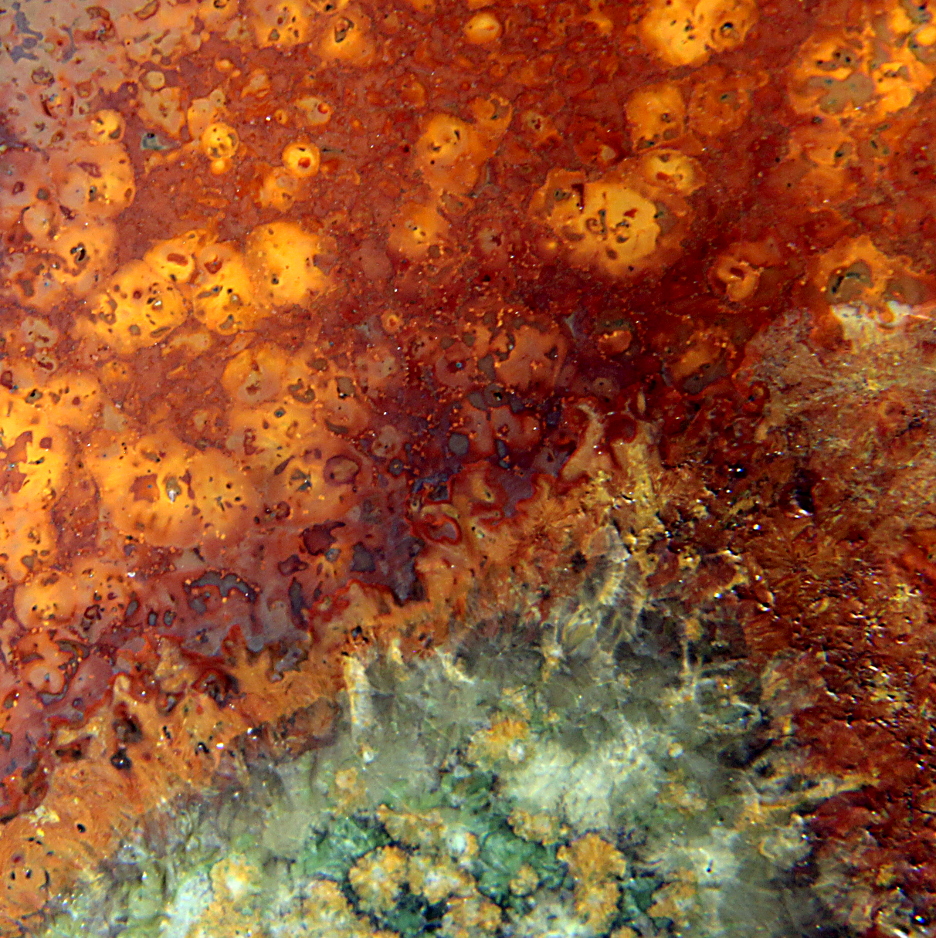
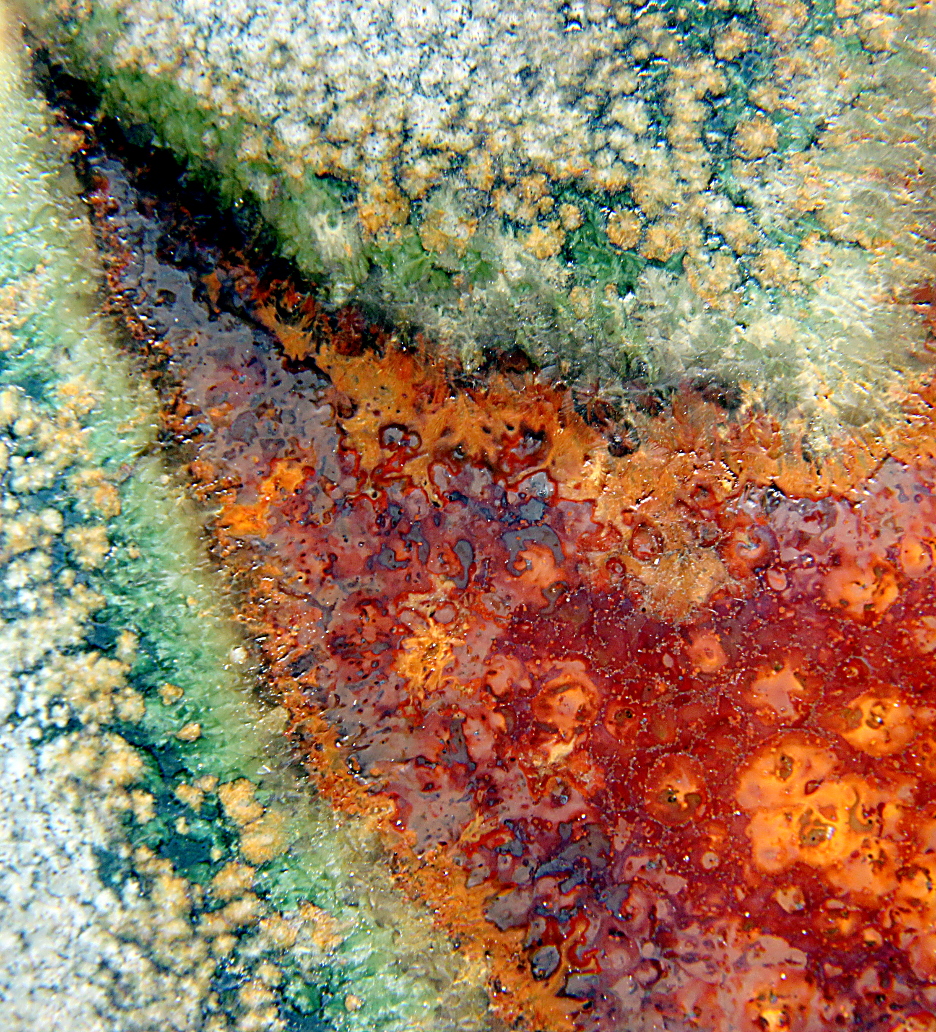
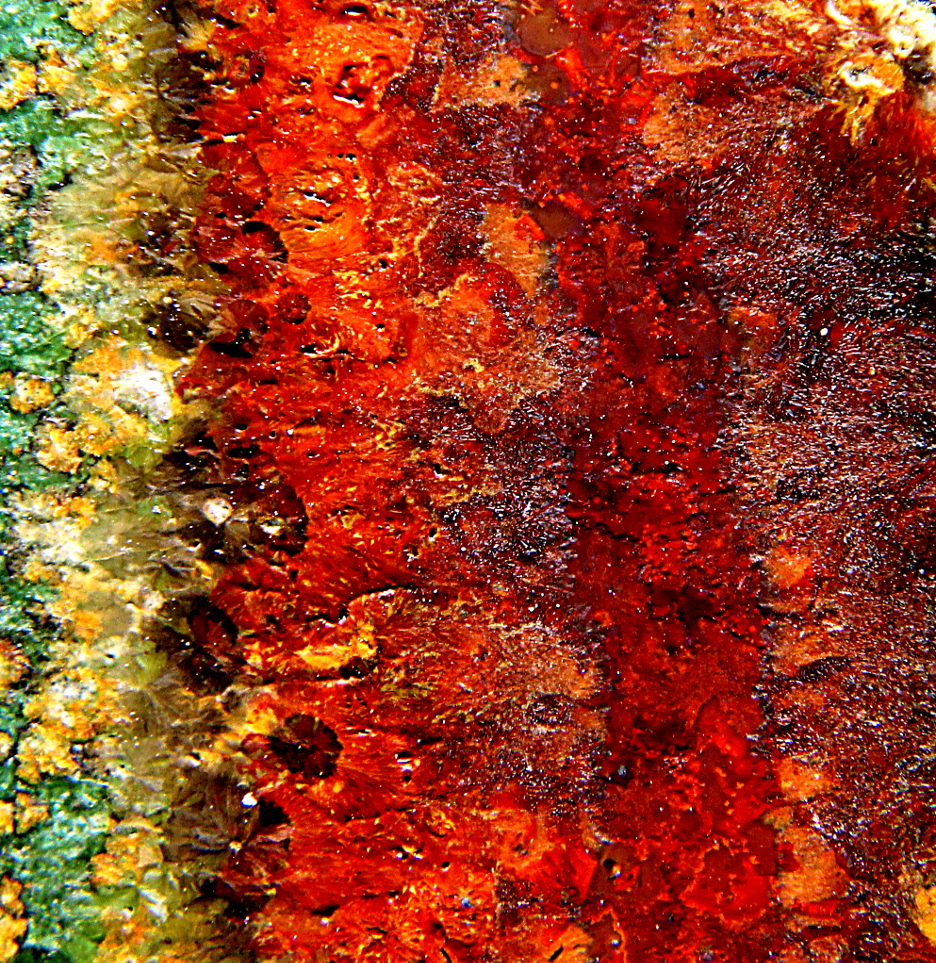
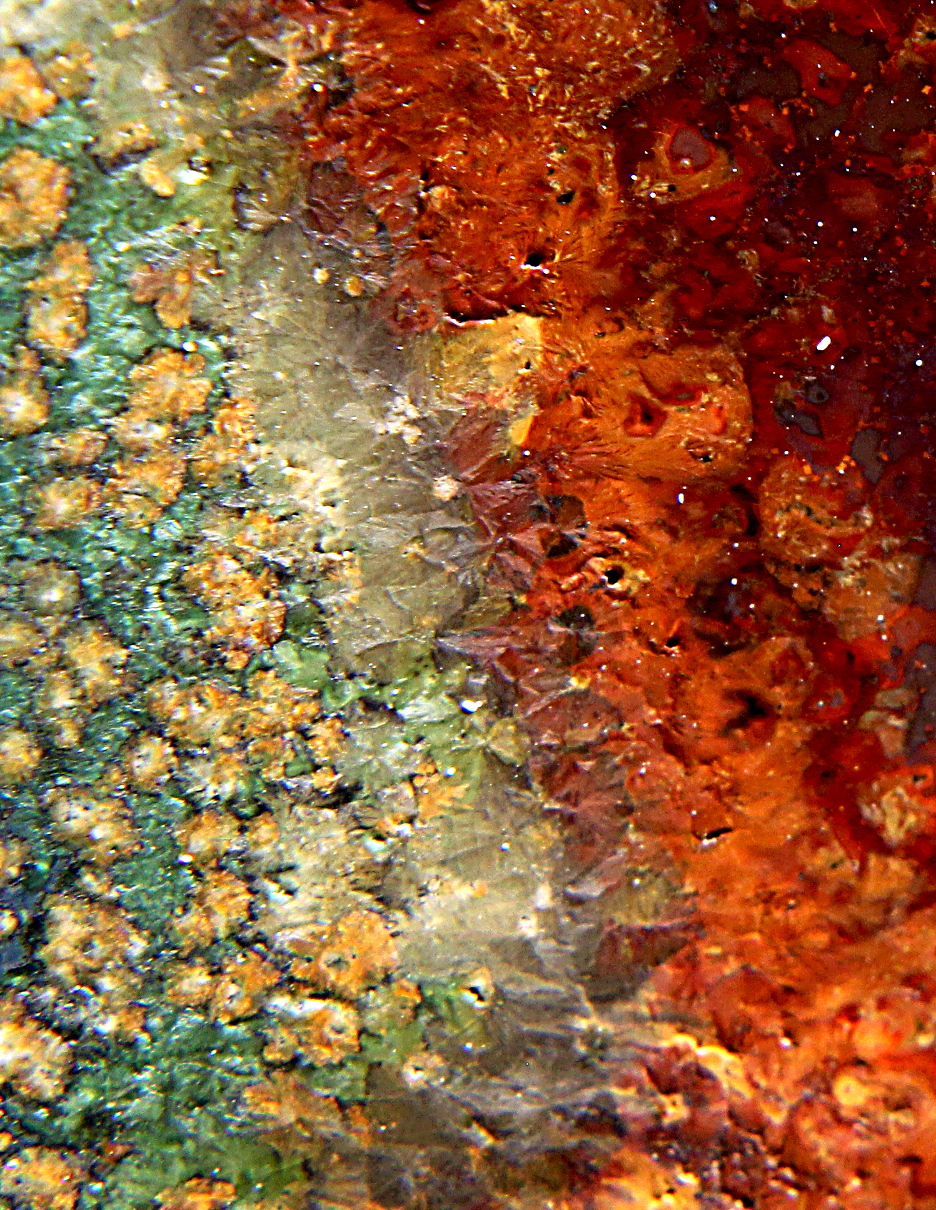
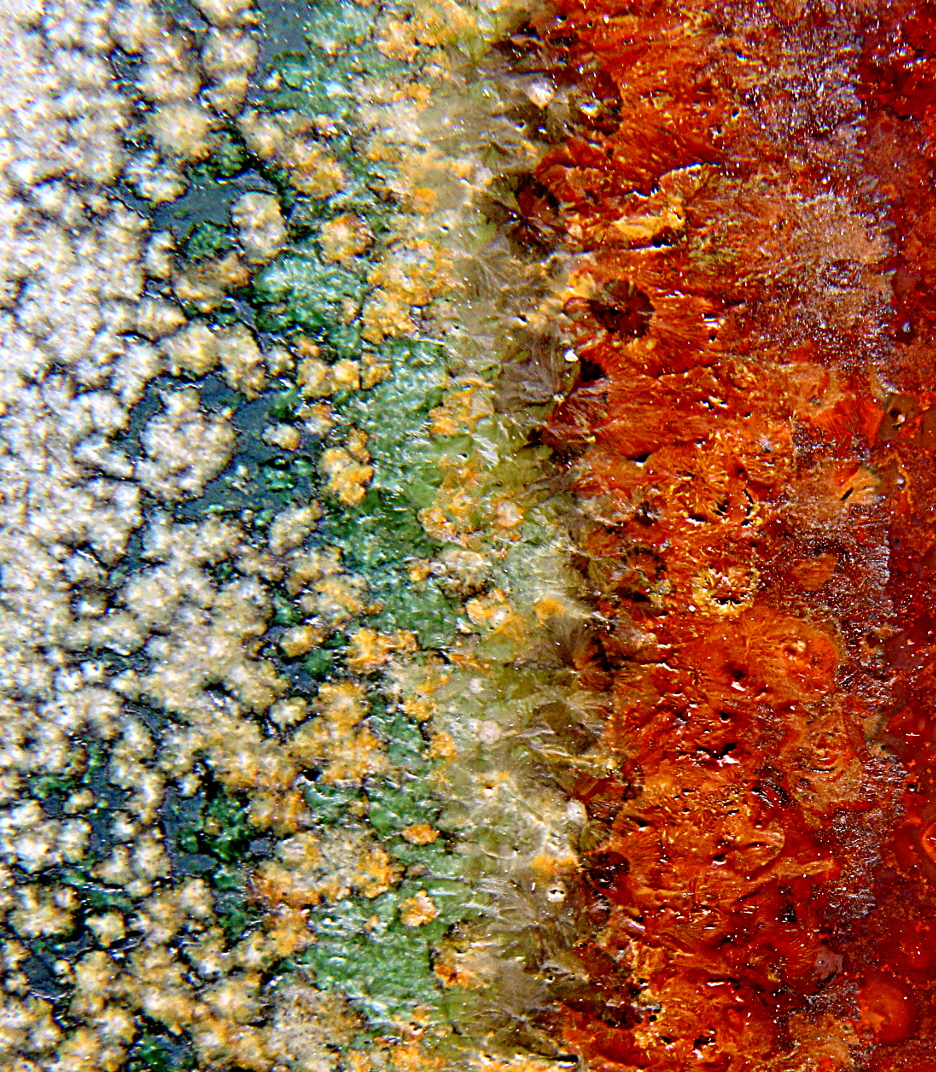
Image of the piece
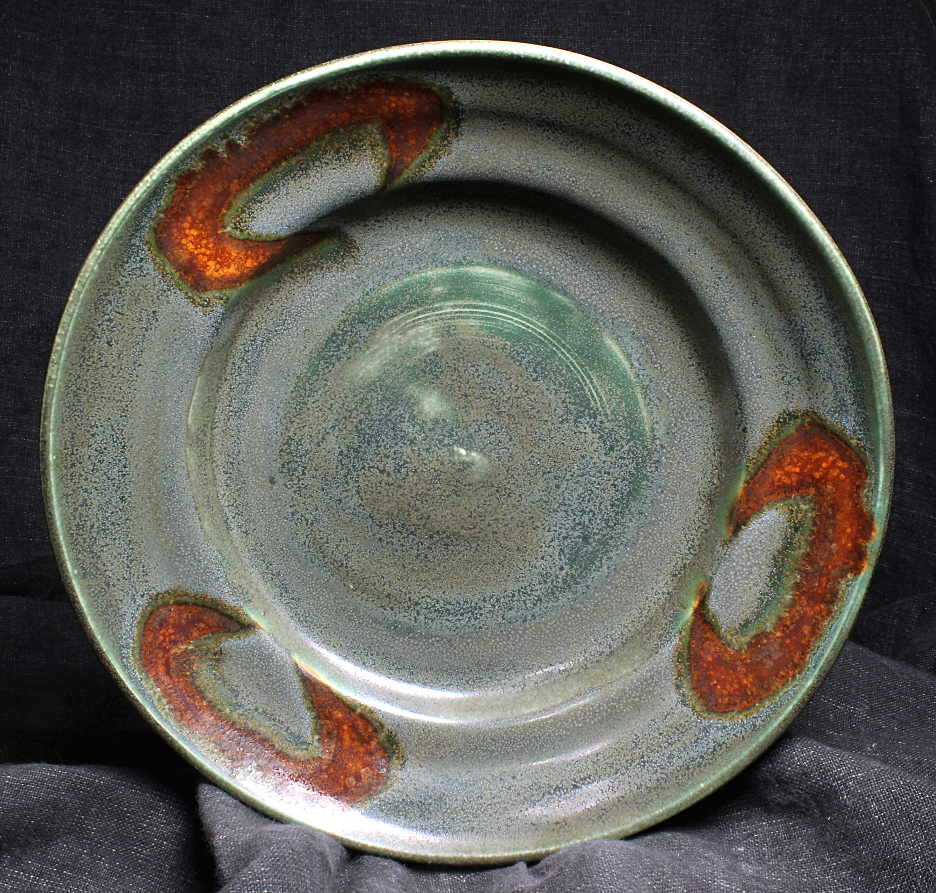
bowl with glaze oribe-woof-PAlZr and inlay glaze hiAlk_satIron_P24_Munge
bowl is ~10 inches in diameter
oxidation firing to almost cone 11 in an electric kiln
Firing profiles
Up Fire profile hot cone 10
Down Fire Profile hot cone 10
Clay body is a grolleg porcelain from Clay Art Center in Tacoma, WA.
glaze composition
Empirical Formula oribe-woof-PAlZr :
Na2O 0.03
CaO 0.71
MgO 0.16
P2O5 0.01
ZrO2 0.11
Inlay Glaze:
Empirical Formula hiAlk_satIron_P24_Munge:
Na2O 0.59
CaO 0.30
MgO 0.03
Fe2O3 0.10
P2O5 0.08
TiO2 0.14
Remarks
below top temperature, and a slow climb from there to
the top temperature.