Glaze Reactions
With a different firing profile we show a new face of the interacting pair of
glazes seen
here .
As above, the background (matrix) glaze is hiAlk_Z3P_Z4E; the inlay design is
glazed with
A change in the downfire protocol provided the titanium in the matrix glaze
the opportunity to grow
The matrix (i.e., background) glaze and inlay glaze overlap minimally before
firing. The width of the
The design is created by adhering a mask and then applying the main
glaze. After drying,
150 deg F an hour to 250 deg F
400 deg F an hour to 1800 deg F
300 deg F an hour to 2050 deg F
120 deg F an hour to 2330 deg F with a hold of 30 minutes at 2330 deg F
300 deg F an hour to 1650 deg F then a 3 hr hold at 1650 deg F
400 deg F an hour to 1850 deg F then a 2 hr hold at 1850 deg F
300 deg F an hour to 1750 deg F then a 1 hr hold at 1750 deg F
300 deg F an hour to 1700 deg F then a 3 hour hold at 1700 deg F
K2O 0.11
Al2O3 0.57
SiO2 3.11
molecular percent Silica 62.7%
K2O 0.10
Al2O3 0.35
SiO2 3.29
molecular percent Silica 70.58%
Added:
5.0% Copper Oxide
Regarding the formation of the various colored micro-crystals surrounding the inlay
within the matrix glaze:
Copper oxide diffuses from the inlay into the matrix glaze, and titanium oxide
diffuses in the other
Titanium crystals present in the glaze will absorb copper which has migrated
from the inlay glaze and will be
The titanium crystals that had already formed in the matrix glaze absorb
copper which had migrated
During the lower temperature holds of the downfire, large titanium crystal
clusters grew. At that
oribe-woof-PAl-PSiMg.
additional crystal clusters after the copper
migration out of the inlay glaze had ended.
original inlay varied from an eighth of an inch to
three eighths of an inch.
the mask is removed and the open area filled in with a
second glaze, using a bulb syringe
with a needle applicator.
Close up Images of the interaction region
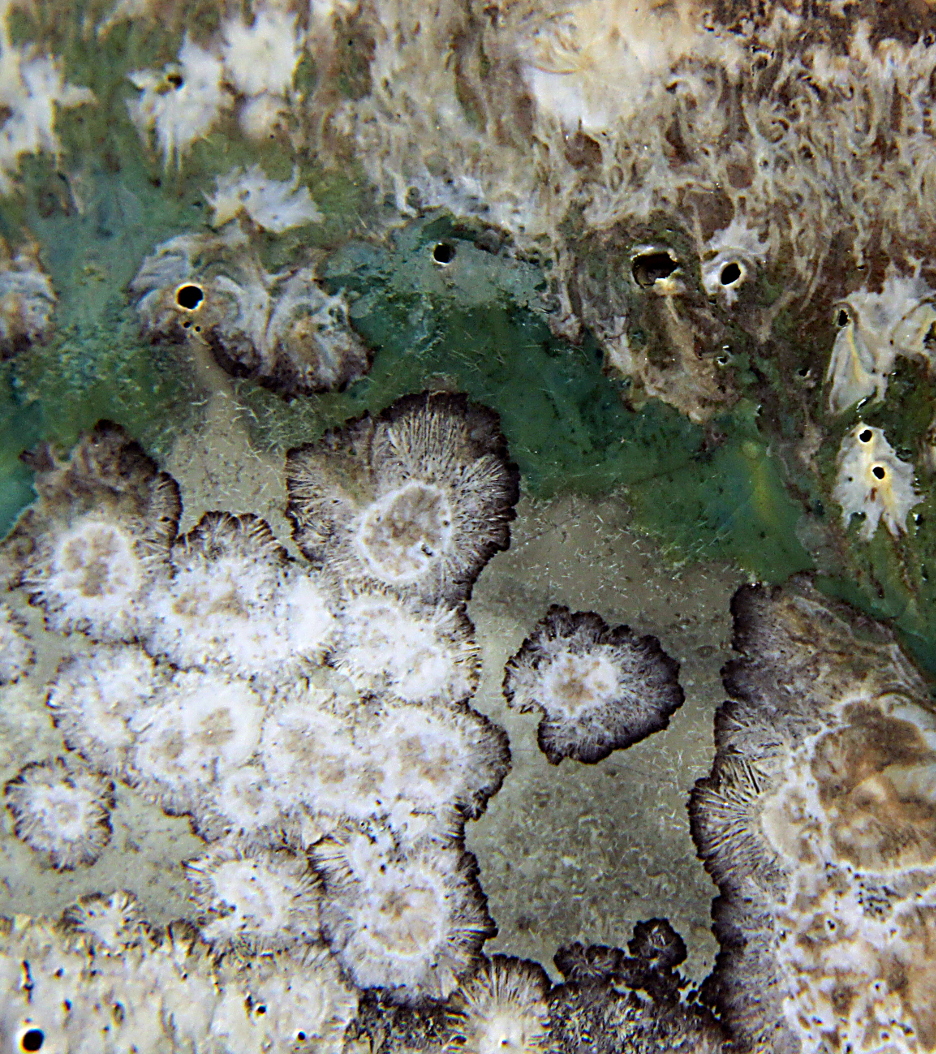
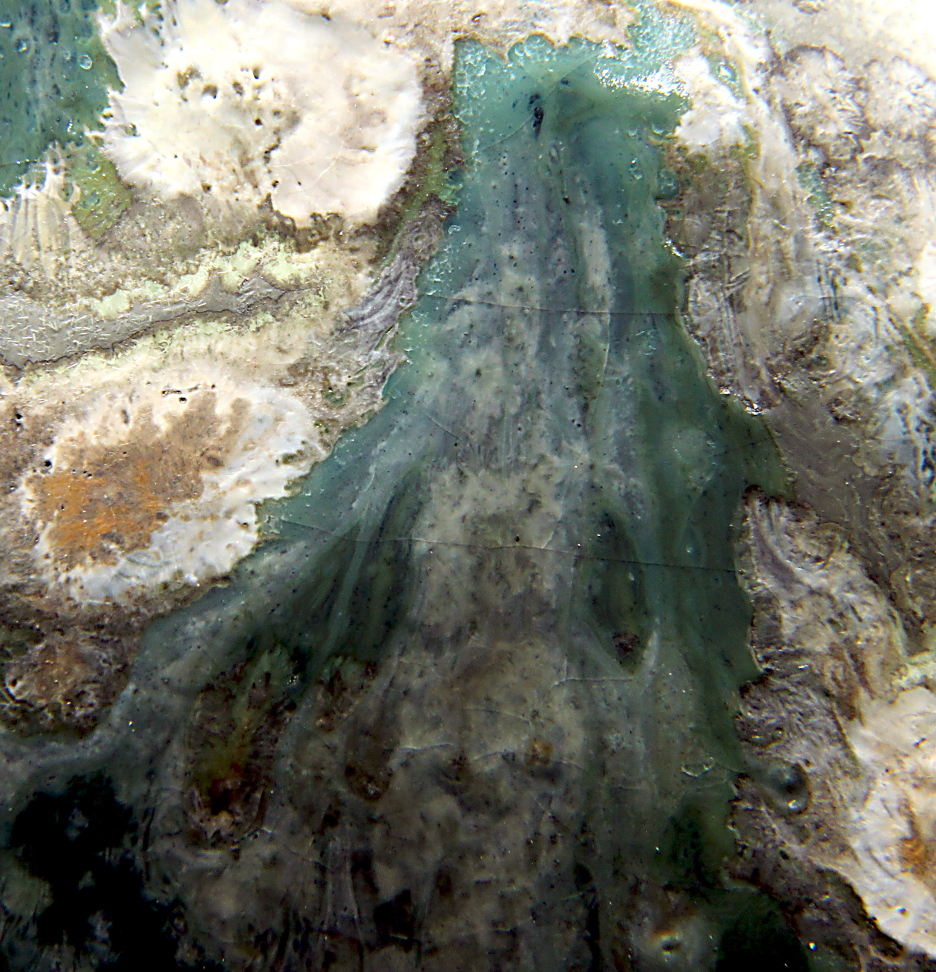
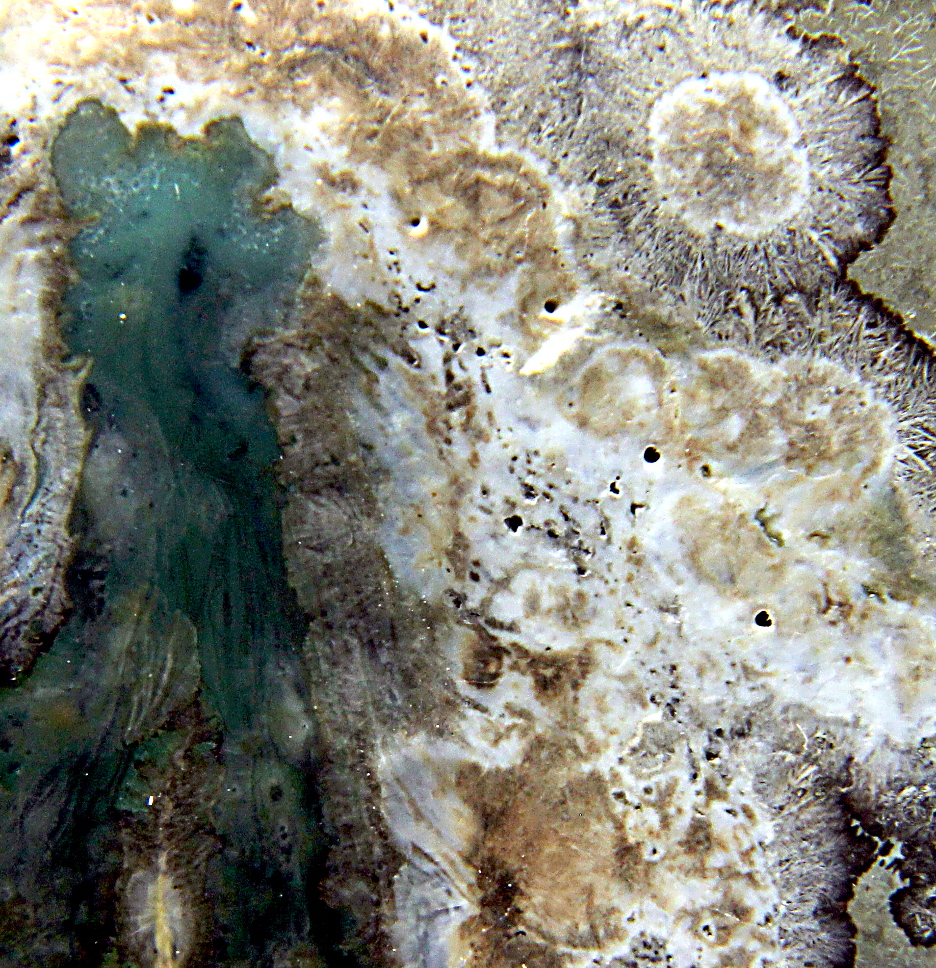
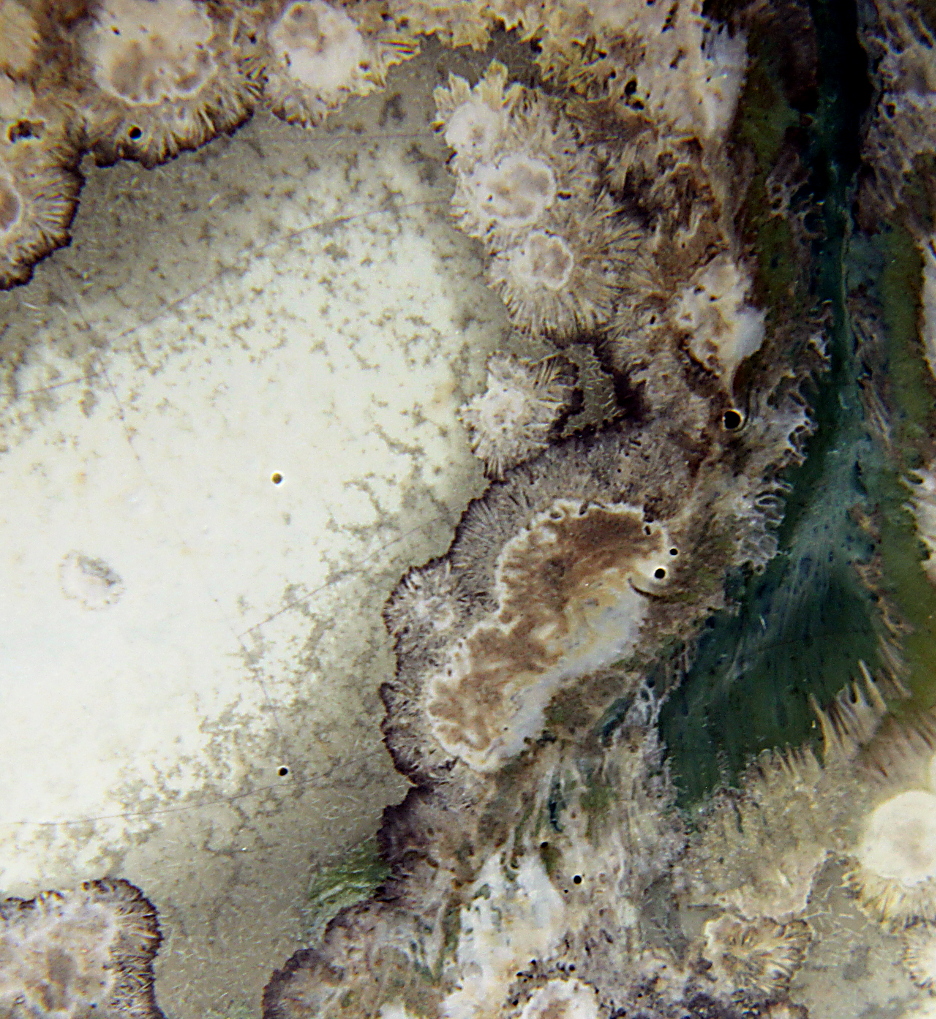
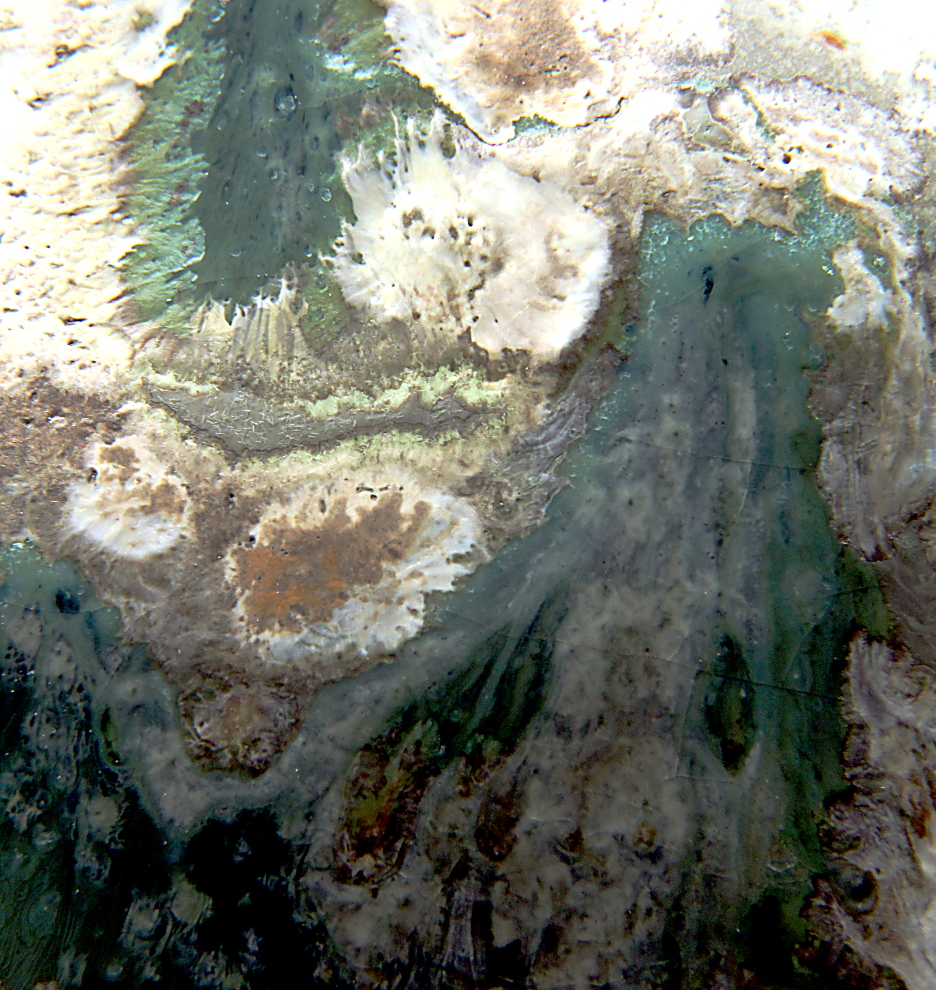
Image of the piece
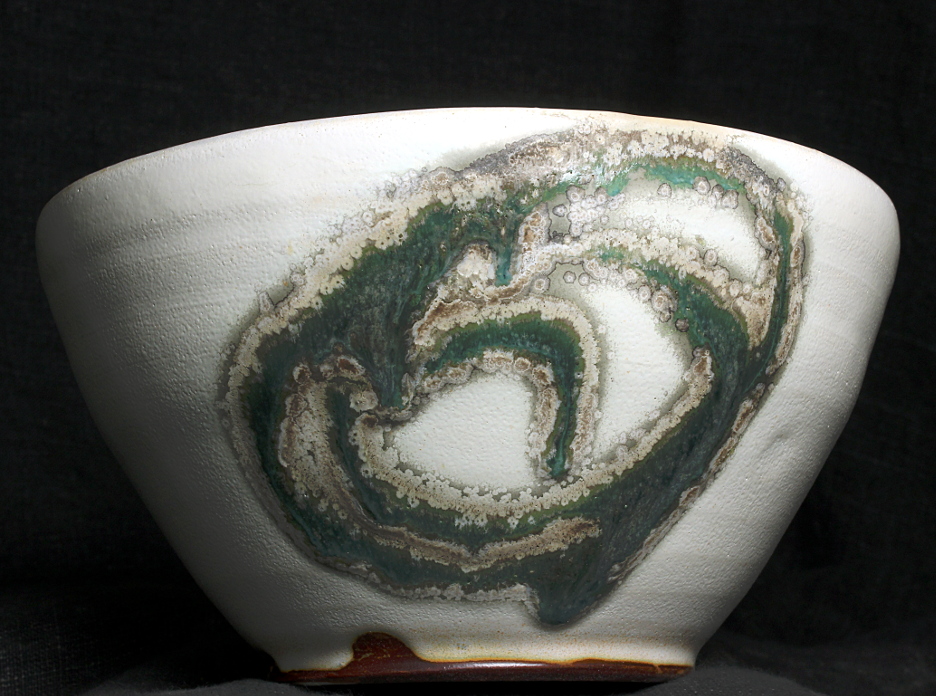
bowl with glaze hiAlk_Z3P_Z4E and inlay oribe-woof-PAl-PSiMg
bowl is ~8 inches in diameter
oxidation firing to cone 11 in an electric kiln
Firing profiles
Up Fire profile cone 11
Down Fire Profile cone 11
Clay body is a grolleg porcelain from Clay Art Center in Tacoma, WA.
glaze composition
Empirical Formula hiAlk_Z3P_Z4E :
Na2O 0.50
CaO 0.37
MgO 0.02
P2O5 0.06
TiO5 0.22
Inlay Glaze:
Empirical Formula oribe-woof-PAl-PSiMg:
Na2O 0.04
CaO 0.61
MgO 0.25
P2O5 0.01
Remarks
direction into the inlay glaze.
browns/greys/orange; yet titanium
crystals that form when the kiln has cooled to the point that the
copper
is no longer mobile will be white.
into the matrix glaze. This is seen in the pale
brown halo beneath the crystal clusters surrounding
the inlay. Copper
migration into titanium crystals is also seen in the large mixed
ivory/brown
and orange micro-crystalline clusters which had formed early in
the firing before the many downfire holds.
temperature the copper is no longer mobile, so these
crystals are white, these are the white snowflake like
crystal clusters at the
outer edge of the inlay.