Glaze Reactions
With a similar firing profile and a small change in the matrix glaze, we show
one more new face
As above, the inlay design is glazed with oribe-woof-PAl-PSiMg.
This firing, while also a cone 11 firing, has a lower final temperature and
shorter hold at that temperature.
With this slight decrease in silica, the balance between when rutile
micro-crystalline
The black band edging the interaction region has reappeared. Much of the
interaction region
Additionally, we see micro-crystalline titanium clusters growing in the
oribe-woof-PAl-PSiMg inlay.
All of this is the result of a small shift in the composition of the matrix
glaze along with a change
The matrix (i.e., background) glaze and inlay glaze overlap minimally before
firing. The width of the
The design is created by adhering a mask and then applying the main
glaze. After drying,
150 deg F an hour to 250 deg F
400 deg F an hour to 1800 deg F
300 deg F an hour to 2050 deg F
120 deg F an hour to 2320 deg F with a hold of 30 minutes at 2320 deg F
300 deg F an hour to 1650 deg F then a 3 hr hold at 1650 deg F
400 deg F an hour to 1850 deg F then a 2 hr hold at 1850 deg F
300 deg F an hour to 1750 deg F then a 1 hr hold at 1750 deg F
300 deg F an hour to 1700 deg F then a 3 hour hold at 1700 deg F
K2O 0.10
Al2O3 0.58
SiO2 2.99
molecular percent Silica 62.3%
K2O 0.10
Al2O3 0.35
SiO2 3.29
molecular percent Silica 70.58%
Added:
5.0% Copper Oxide
See prior note for details on the relative formation of colored and white
titanium crystals.
of the interaction between a high titanium glaze and an
oribe glaze.
Here we see the matrix glaze
hiAlk_Z3P_Z4E with inlay glaze
oribe-woof-PAl-PSiMg.
However the
background glaze is hiAlk_Z3P_Z4E_0MTi, a close relative of the former with a
bit
less silica and also less titanium.
clusters grow and copper migrates at an appreciable
rate into the matrix glaze has shifted. The result
is that we have white
titanium crystal clusters with black edges, and grey-black crystal cluster
with
white edging. Clearly crystals grow, and copper migrates at the
same time, and all is determined
by relative speed of growth vs. oxide
movement in a particular region.
is covered in a lacy black border of titanium crystals.
in the firing profile. Undoubtedly the glaze
application thickness also differed and had its effect.
original inlay varied from an eighth of an inch to
three eighths of an inch.
the mask is removed and the open area filled in with a
second glaze, using a bulb syringe
with a needle applicator.
Close up Images of the interaction region
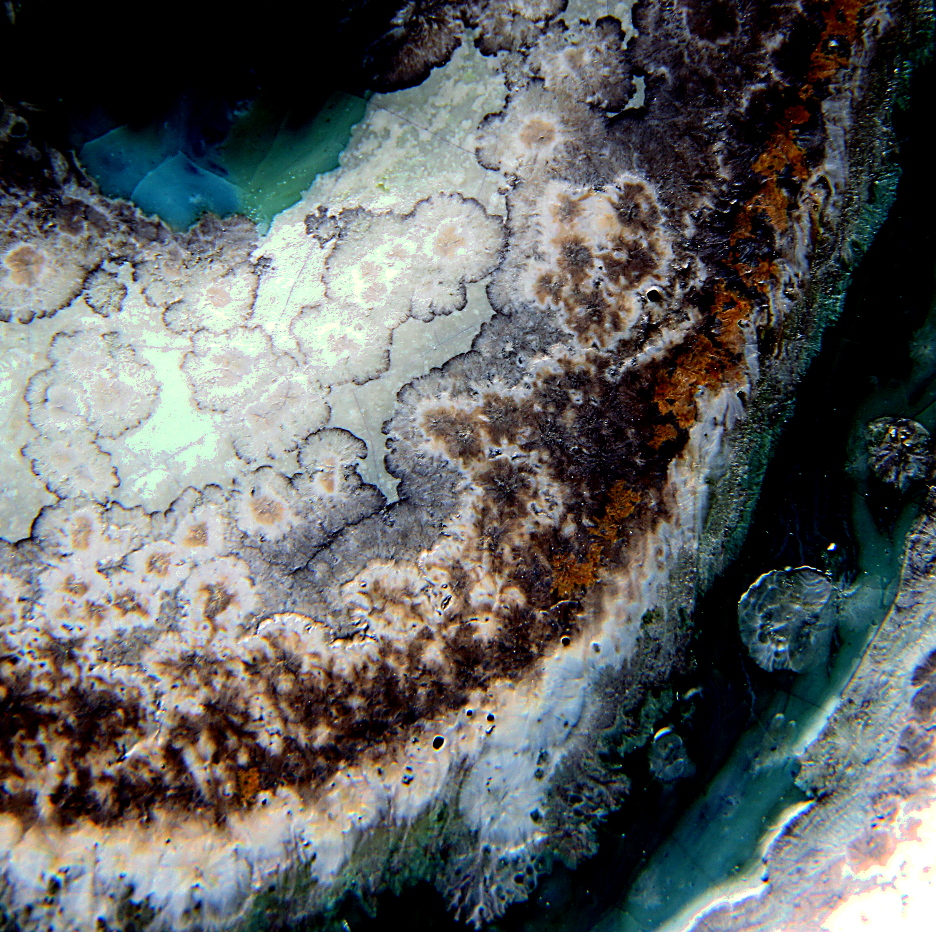
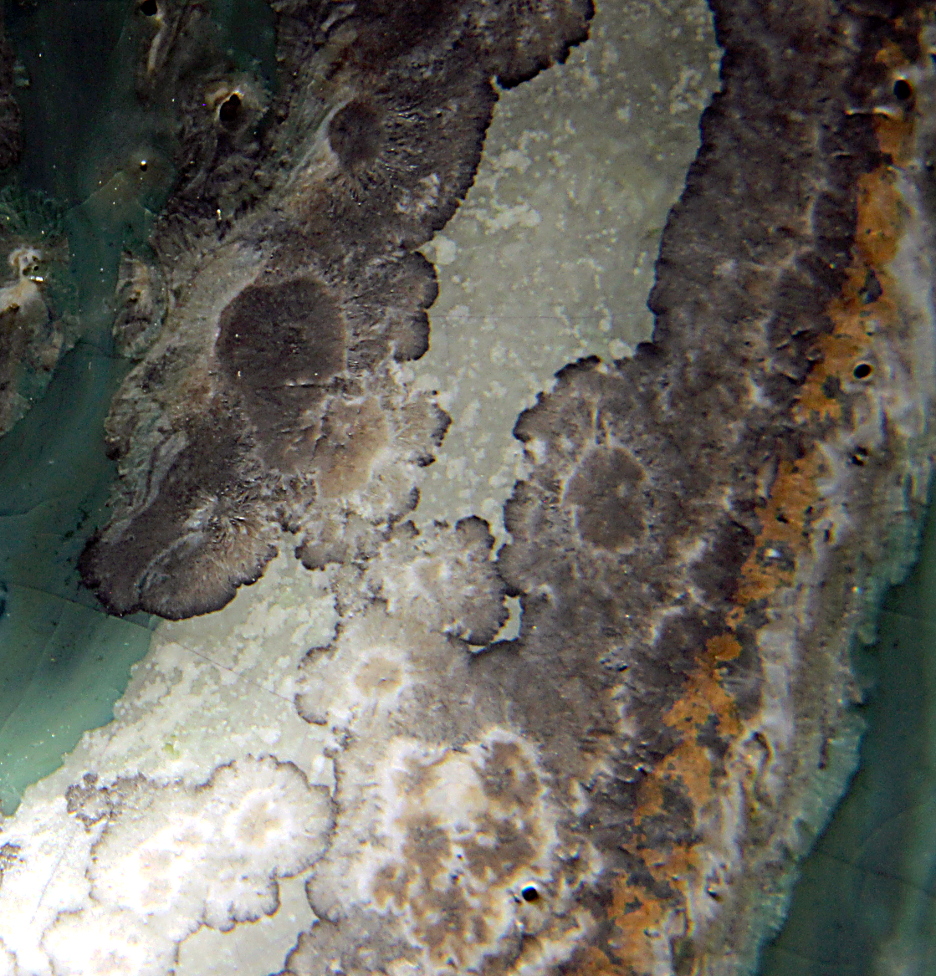
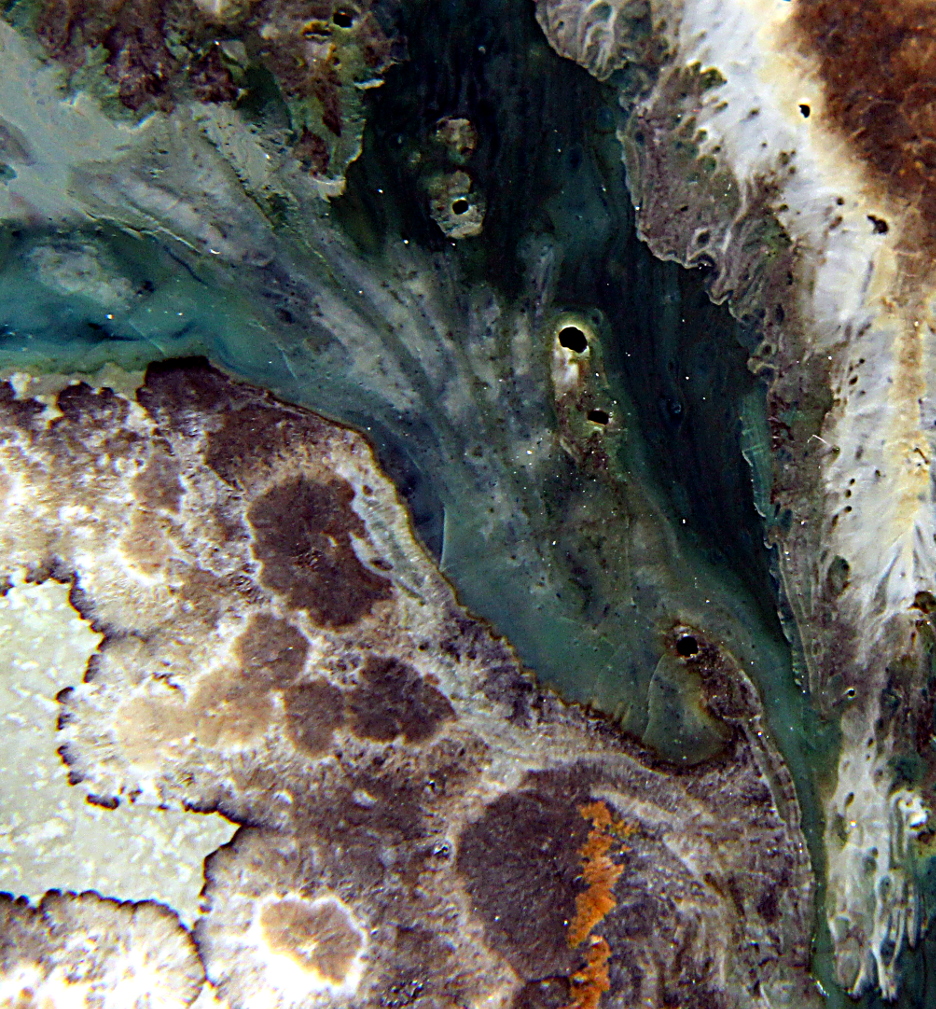
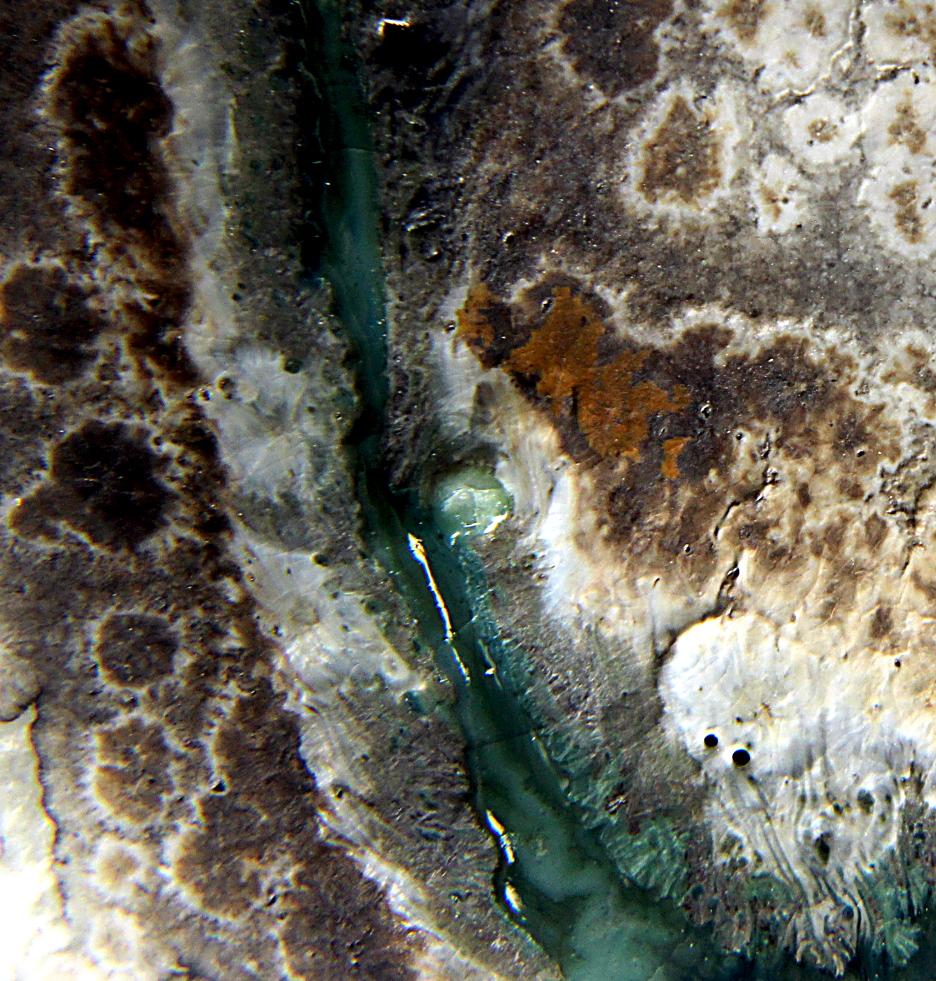
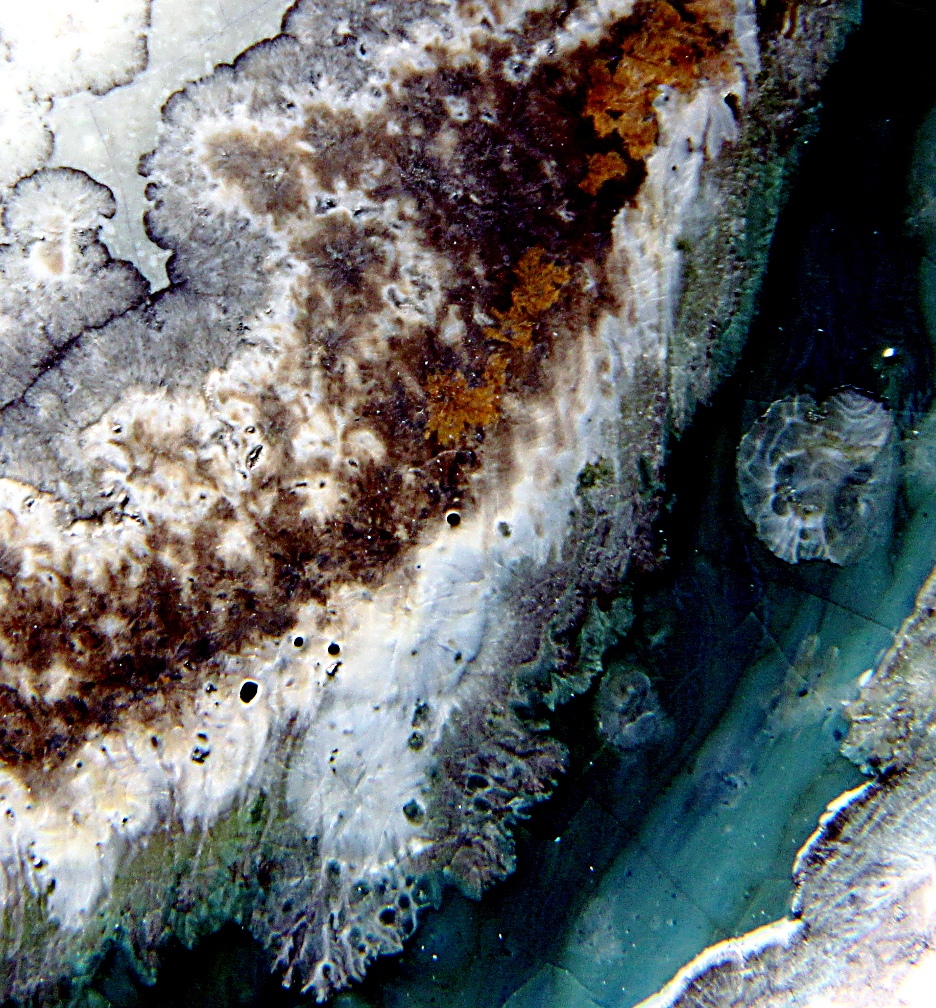
Image of the piece
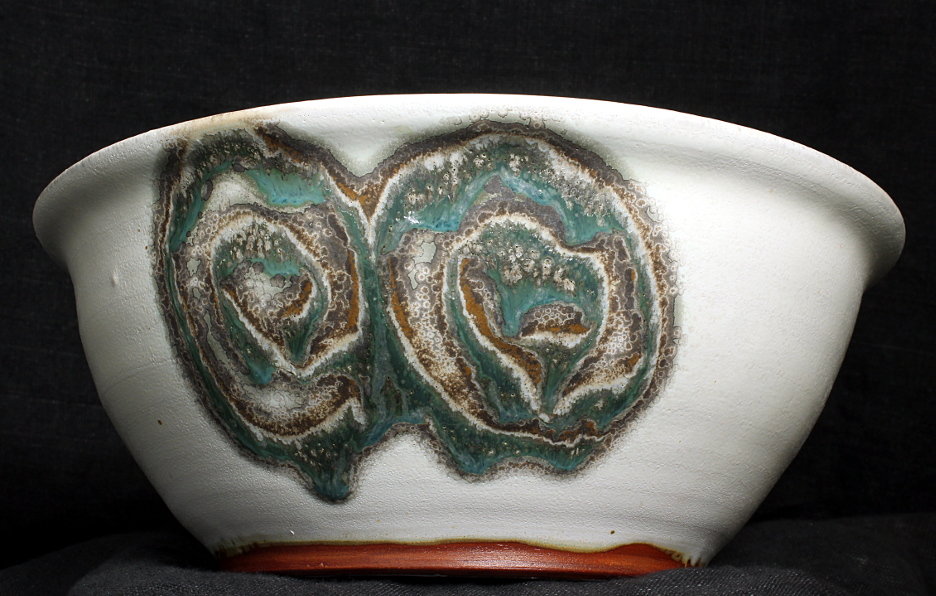
bowl with glaze hiAlk_Z3P_Z4E_0MTi and inlay oribe-woof-PAl-PSiMg
bowl is ~9.5 inches in diameter
oxidation firing to cone 11 in an electric kiln
Firing profiles
Up Fire profile cone 11
Down Fire Profile cone 11
Clay body is a grolleg porcelain from Clay Art Center in Tacoma, WA.
glaze composition
Empirical Formula hiAlk_Z3P_Z4E_0MTi :
Na2O 0.48
CaO 0.40
MgO 0.02
P2O5 0.06
TiO5 0.19
Inlay Glaze:
Empirical Formula oribe-woof-PAl-PSiMg:
Na2O 0.04
CaO 0.61
MgO 0.25
P2O5 0.01
Remarks