results in an altered firing
More explorations in slowing the approach to maturity, otherwise known as the
"up" part of the firing;
An example of a different pair of glazes with this firing profile is seen
here:
The matrix (i.e., background) glaze and inlay glaze overlap minimally before
firing. The width of the
The background glaze is hiAlk_satIron_P24_Munge; the inlay design is glazed with
The matrix glaze in this firing is a volumetric mixture of two glazes, so the
empirical formula
The design is created by adhering a mask and then applying the main
glaze. After drying,
The close-up images were heavily edited to enhance detail, and colors are
brighter as a result.
150 deg F an hour to 250 deg F
300 deg F an hour to 2050 deg F
120 deg F an hour to 2250 deg F then a 1 hr hold at 2250 deg F
90 deg F an hour to 2310 deg F with a hold of 20 minutes at 2310 deg F
300 deg F an hour to 1850 deg F then a 2 hr hold at 1850 deg F
300 deg F an hour to 1750 deg F then a 1 hr hold at 1750 deg F
300 deg F an hour to 1700 deg F then a 3 hr hold at 1700 deg F
25 deg F an hour to 1650 deg F then a 1 hr hold at 1650 deg F
K2O 0.08
Al2O3 0.58
SiO2 3.53
molecular percent Silica 65.1%
K2O 0.17
Al2O3 0.35
SiO2 3.3
molecular percent Silica 70.68%
Added:
5.0% Copper Oxide
This firing features a 'rounded at the top' firing profile; with a hold
of an hour 60 degreesF
The orange in the large flat crystals seen at the edge of the inlay is iron
diffusing into the crystals.
this in addition to having the usual holds on
the way down. These firings are in an electric kiln.
original inlay varied from an eighth of an inch to
three quarters of an inch, which is considerably thicker
than my usual inlay.
oribe-woof-PAlkAl-PSiMg
given below is an approximation.
the mask is removed and the open area filled in with a
second glaze, using a bulb syringe
with a needle applicator.
The colors of the full image of the bowl are as they
appear in bright light.
Close up Images of the interaction region
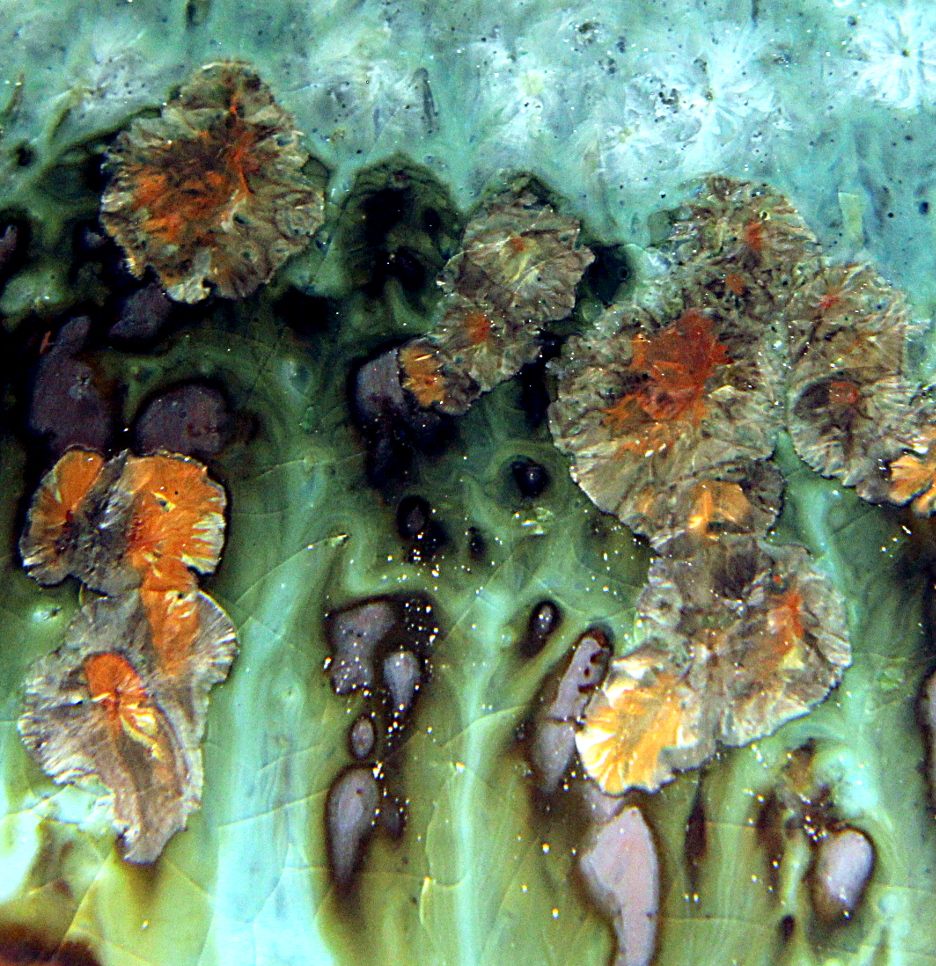
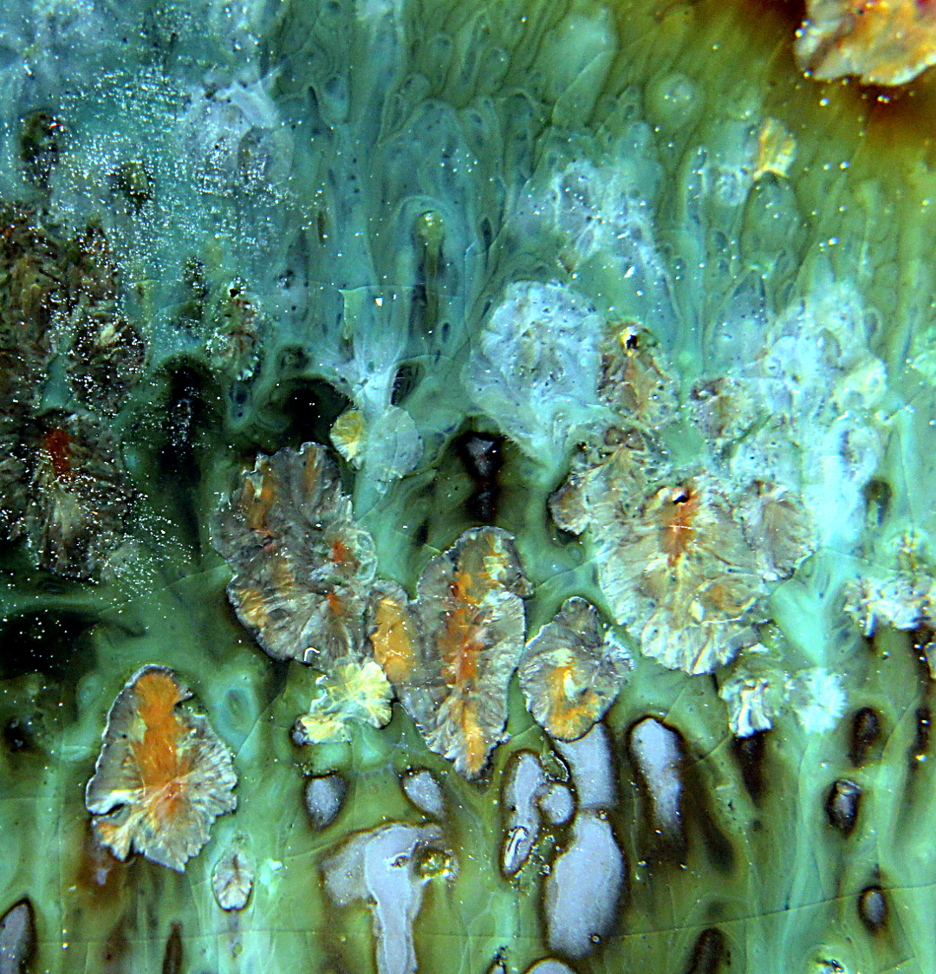
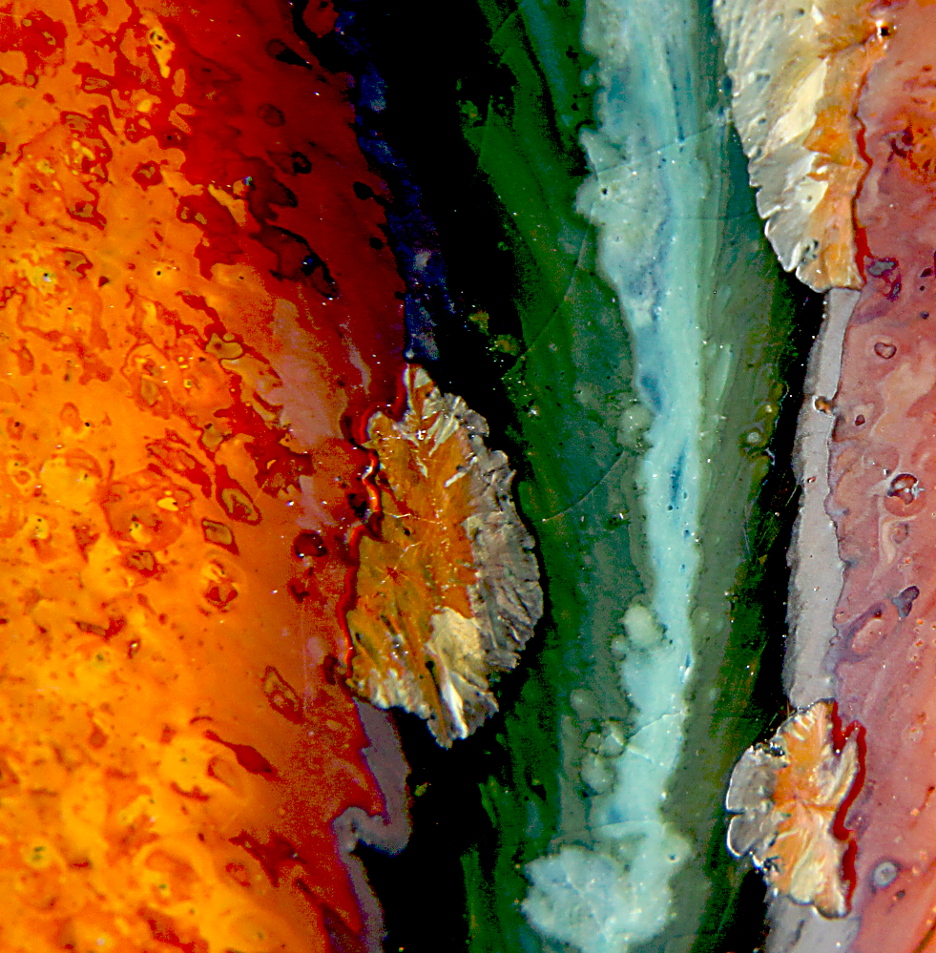
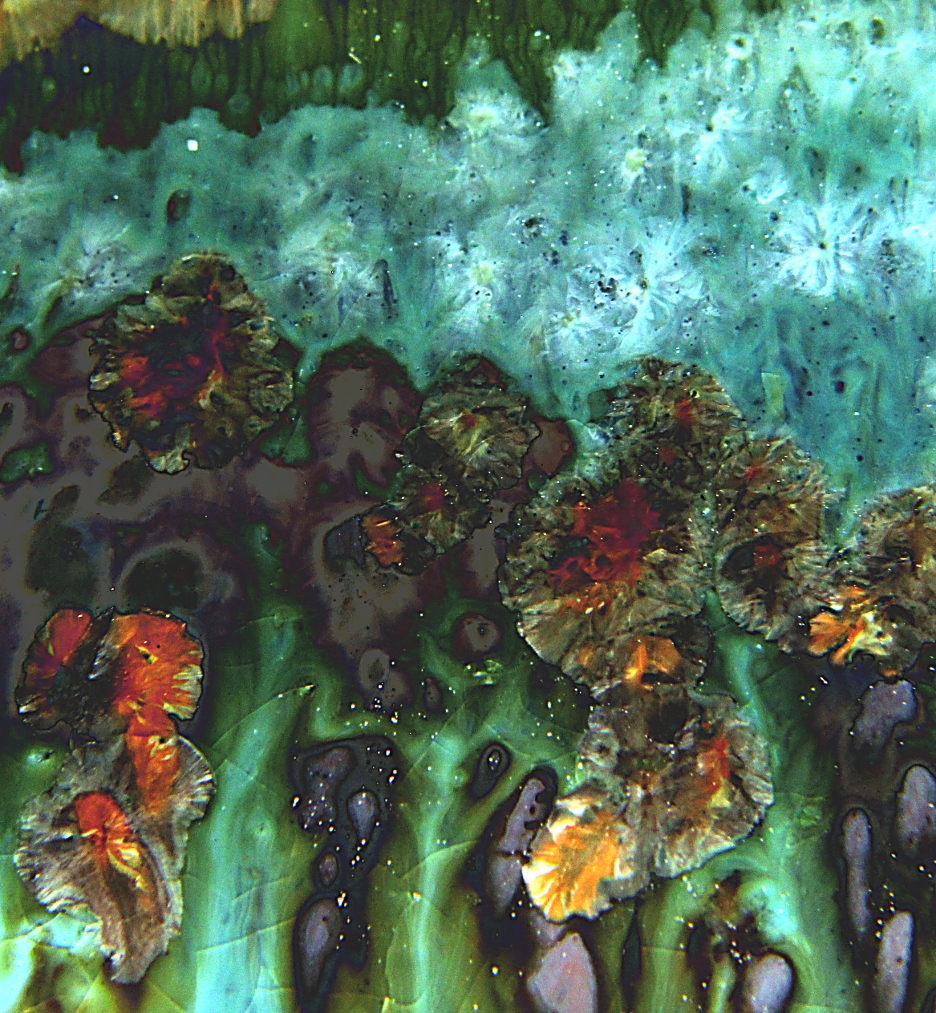
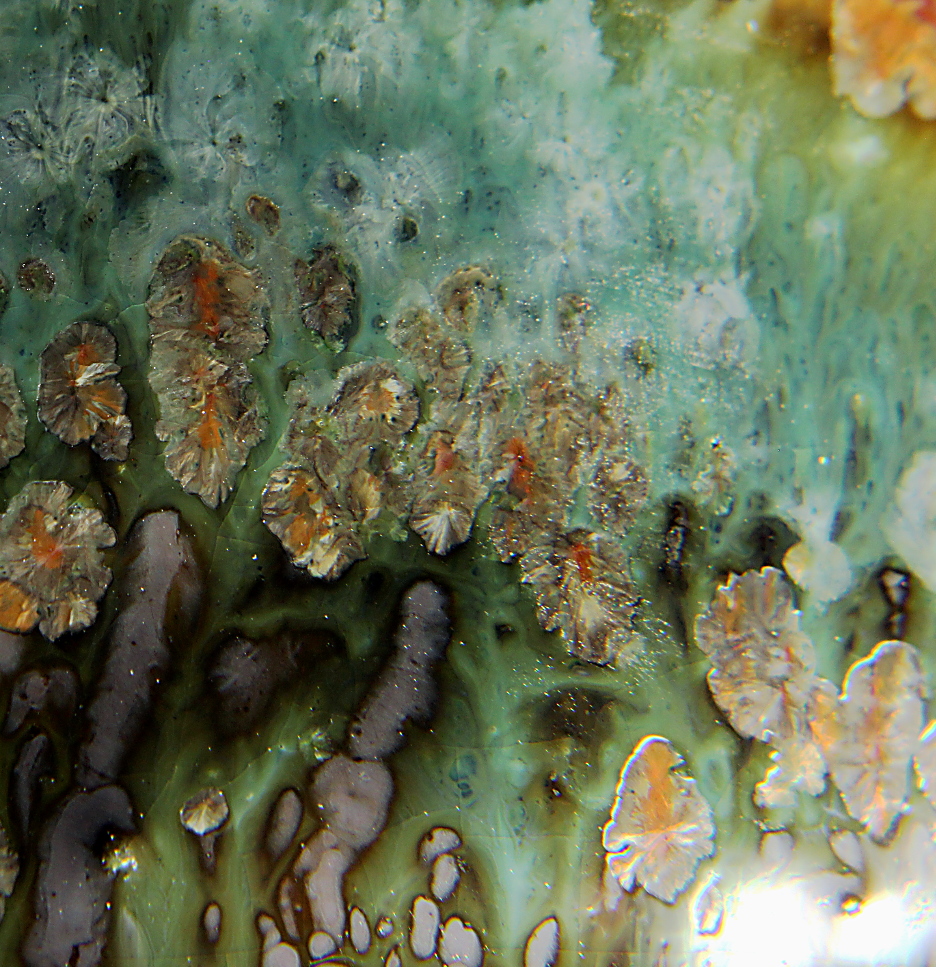
Image of the piece
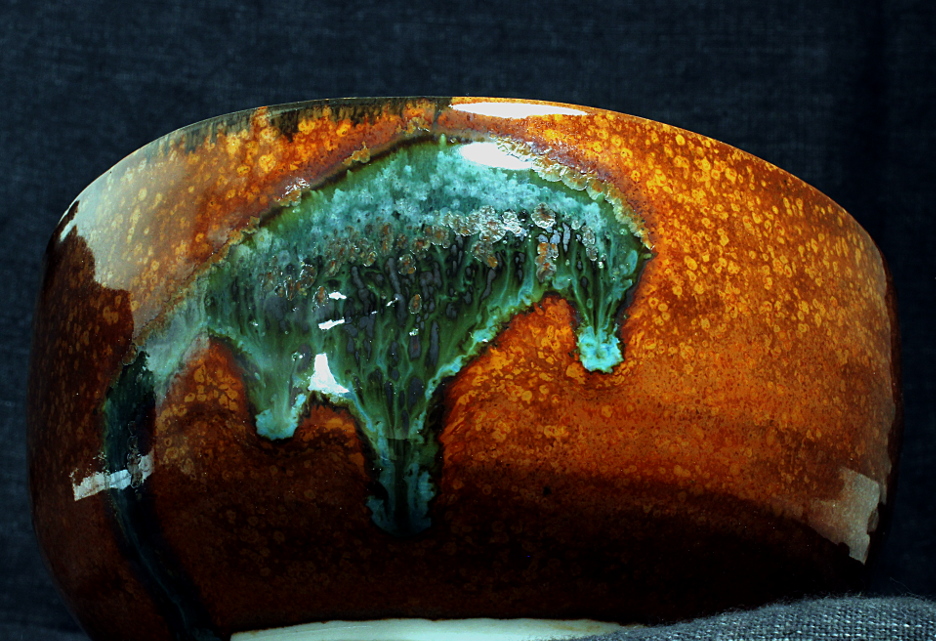
bowl with glaze hiAlk_satIron_P24_Munge and inlay glaze oribe-woof-PAlkAl-PSiMg
bowl is ~6 inches in diameter
oxidation firing to almost cone 11 in an electric kiln
Firing profiles
Up Fire profile hot cone 10
Down Fire Profile hot cone 10
Clay body is a grolleg porcelain from Clay Art Center in Tacoma, WA.
glaze composition
Empirical Formula hiAlk_satIron_P24_Munge :
Na2O 0.59
CaO 0.30
MgO 0.03
Fe2O3 0.10
P2O5 0.08
TiO2 0.14
Inlay Glazes:
Empirical Formula oribe-woof-PAlkAl-PSiMg:
Na2O 0.05
CaO 0.49
MgO 0.29
P2O5 0.01
Remarks
below top temperauture, and a slow climb from there to
the top temperature.
These large flat crystals were not previously
seen in the glaze oribe-woof-PAlk-PSiMg.